
Your offshore team’s hourly rate is $35. Your US team’s rate is $120. The math seems obvious.
But here’s what the math doesn’t show: the three-day turnaround on a bug fix that should have taken two hours. The sprint that slipped because a blocker sat untouched during a 12-hour timezone gap. The senior developer who quit after six months - the third one this year - taking all the context with them.
When you add up the rework cycles, the management overhead, the knowledge drain from constant turnover, and the velocity you’re quietly losing to async communication, that $35 rate starts looking a lot more expensive.
The Hidden Tax on Every Offshore Hour
The sticker price of offshore development - typically 60-80% below US rates - is real. Nobody disputes that. What gets buried in quarterly reviews is the compounding cost of everything that happens around those cheap hours.
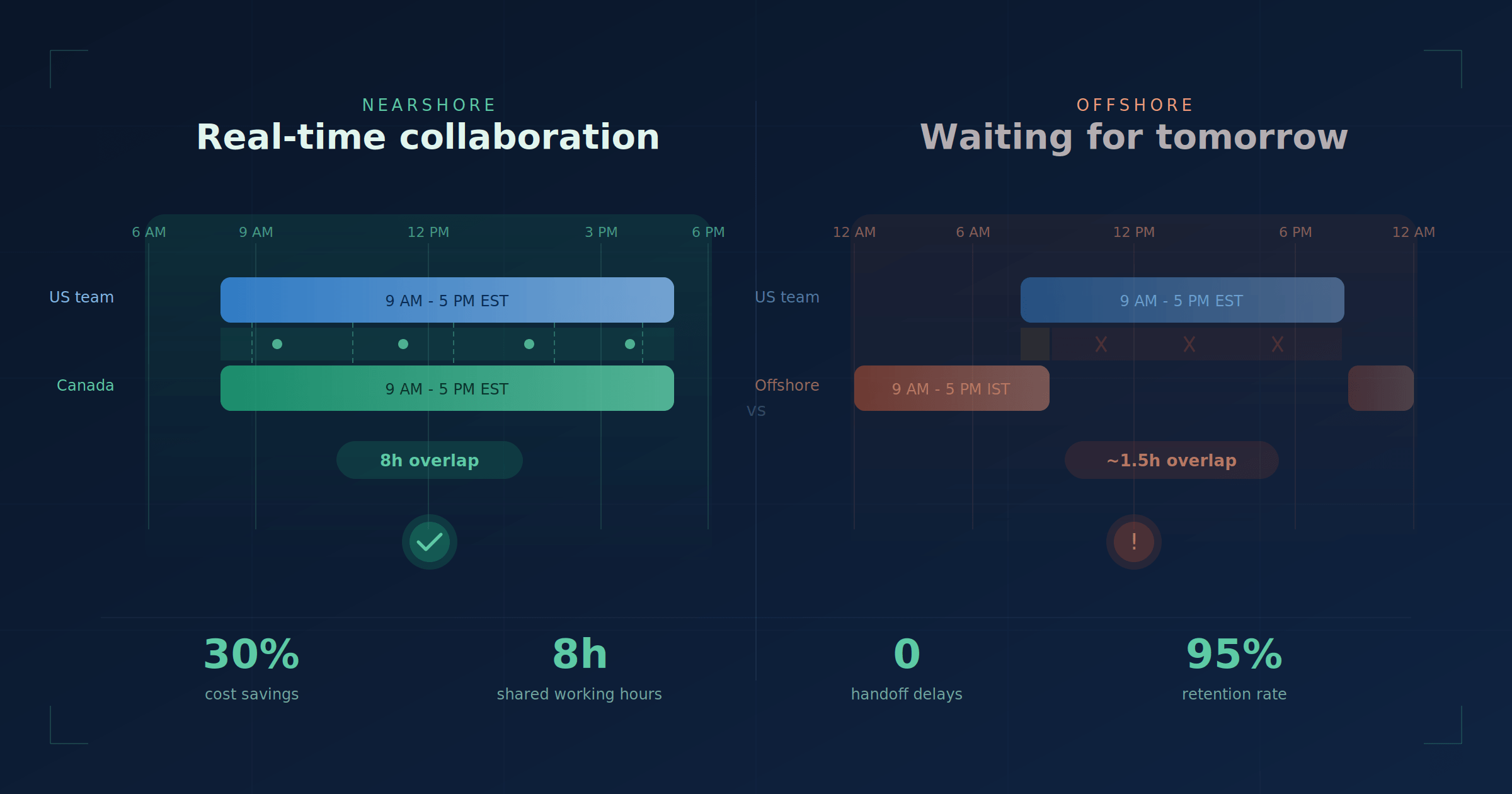
Start with communication overhead. Offshore teams operating 8-12 hours ahead of (or behind) your US-based engineering leadership create 24-48 hour feedback loops on routine decisions. A question that would get answered in a five-minute Slack exchange at 2pm turns into a handoff note that gets read tomorrow morning in Mumbai, responded to by their end of day, and lands back on your desk the following morning. That’s two days for a five-minute conversation.
Now multiply that across an entire sprint. Blockers don’t get cleared same-day. Design clarifications lag. Code reviews pile up in queues that move once per timezone rotation. The result isn’t dramatic - it’s a slow, steady erosion of velocity that’s hard to measure and easy to ignore until you realize your team is shipping 30-40% slower than they should be.
Then there’s the quality loop. When developers can’t quickly clarify requirements or get real-time feedback during implementation, they make assumptions. Some are right. Many aren’t. The code gets written, reviewed asynchronously, and the misalignment surfaces two weeks later during QA or, worse, in production. Rework becomes a recurring line item that nobody budgets for.
Developer Attrition Is Eating Your Savings
Here’s the number that should alarm every engineering leader relying on offshore talent: major offshore markets like India and Vietnam are seeing 20-30% annual developer attrition rates. Wage inflation in these markets is accelerating, and top developers are getting poached constantly.
Every time a developer leaves, you lose more than a headcount. You lose the accumulated context about your codebase, your product decisions, your architectural quirks. Developer retention is the hiring metric that actually matters — and offshore models make it nearly impossible to optimize for. Replacing an engineer costs 1.5 to 2 times their annual salary when you factor in recruiting, onboarding, ramp-up time, and the productivity dip that ripples through the team.
If you’re running a team of eight offshore developers and losing two or three per year, you’re spending the equivalent of several full-time salaries just treading water. That “cost savings” starts to evaporate.
And it’s not just about money. Attrition destroys team cohesion. The developers who stay have to constantly re-explain systems, re-review old decisions, and carry the weight of institutional knowledge that keeps walking out the door. It’s exhausting, and it creates a second-order retention problem - your best remaining people start looking for more stable environments.
Why Nearshore Canadian Developers Change the Equation
The offshore model isn’t broken because the developers are bad. Many offshore engineers are genuinely talented. The model is broken because geography creates friction that compounds over time - timezone gaps, cultural misalignment in communication styles, and a transactional talent market that makes retention nearly impossible.
Nearshore hiring - specifically, hiring Canadian developers for US companies - eliminates these friction points without giving up meaningful cost efficiency.
Same timezone, real-time collaboration. Canadian developers work the same hours you do. EST, CST, MST, PST - pick your zone, Canada covers them all. When a blocker comes up during a sprint, it gets resolved the same day. Code reviews happen in real-time. Architectural discussions are actual conversations, not async documents that lag by 24 hours.
North American work culture alignment. This is the one that’s hard to put a dollar value on but shows up immediately in team dynamics. Canadian developers share the same communication norms, meeting culture, and collaboration expectations as US teams. There’s no adjustment period for directness in feedback, no misalignment on what “done” means, no cultural friction around pushing back on unrealistic timelines. They integrate like local hires because, culturally, they nearly are.
Meaningful cost efficiency vs. US hiring. You’re not getting offshore-level discounts. You’re getting real savings with none of the hidden costs that erode offshore savings to near-zero. A Canadian developer delivers significantly more net value than an offshore developer at a similar rate when you factor in velocity, retention, and management overhead.
Dramatically better retention. The Canadian tech talent market doesn’t have the same attrition dynamics as offshore markets. Developers aren’t getting poached every six months by the next outsourcing firm offering a 10% bump. At DecodeTalent, our placements hold a 95% retention rate - not because we got lucky, but because we screen for long-term fit from day one. We assess technical depth, communication style, cultural alignment, and career trajectory. It’s slower than blasting resumes. It’s also why our clients aren’t constantly backfilling.
The Vetting Problem Most Companies Don’t Talk About
There’s another cost buried in the offshore model: the cost of figuring out who’s actually good.
Most offshore staffing firms optimize for speed. They keyword-match resumes, run a basic screening call, and send you a batch of candidates. The technical evaluation - the part that actually matters - falls on your engineering team. Your senior developers spend hours interviewing candidates who look great on paper but can’t reason through a system design question. That’s expensive time burned on someone else’s job.
At DecodeTalent, vetting works differently because our founder, Shawn Mayzes, actually builds software. He runs Jetpack Labs, a software development consultancy, alongside DecodeTalent. That means candidates are evaluated by someone who reviews pull requests, designs architectures, and ships production code - not someone who learned to ask “tell me about a time you used microservices” from a recruiting playbook.
This matters more than it sounds. A technical founder can spot the difference between a developer who memorized system design answers and one who’s actually built distributed systems under pressure. That signal doesn’t come through on a resume or a 30-minute phone screen. It comes through in the depth of conversation that only happens when the interviewer genuinely understands the work.
And our developers don’t stop growing after placement. Through the Decode Academy, every placed candidate gets access to ongoing upskilling in AI-led development, advanced systems architecture, and market insights. Companies get developers who are actively leveling up - not coasting on the skills they had when they were hired.
Rethinking the Math
The real question isn’t “how do we get the cheapest developers?” It’s “how do we get the most value per engineering dollar?”
When you optimize for rate, you get offshore. When you optimize for output - actual shipped software, retained knowledge, team velocity, reduced management overhead - the math points somewhere different.
Canadian nearshore talent won’t give you the lowest line item on a spreadsheet. But it will give you developers who ship faster because they’re in your timezone, stay longer because they’re in a healthy talent market, integrate seamlessly because they share your work culture, and keep getting better because they’re investing in their own growth.
The companies that figured this out aren’t going back to offshore. They’re scaling their Canadian teams.
If you’re ready to see what that looks like for your engineering org, book a discovery call. We’ll walk through your current setup, where you’re leaking value, and what a nearshore team could look like - no pitch, just an honest assessment.
More Insights
March 2026
Why Time Zone Alignment Matters More Than Cost Savings in Tech Hiring
Time zone misalignment kills engineering velocity. Canadian nearshore developers work your hours, ship faster, and cost less than offshore rework. Here is why alignment beats cheap rates.
March 2026
Remote Work Best Practices for Canadian Nearshore Development Teams
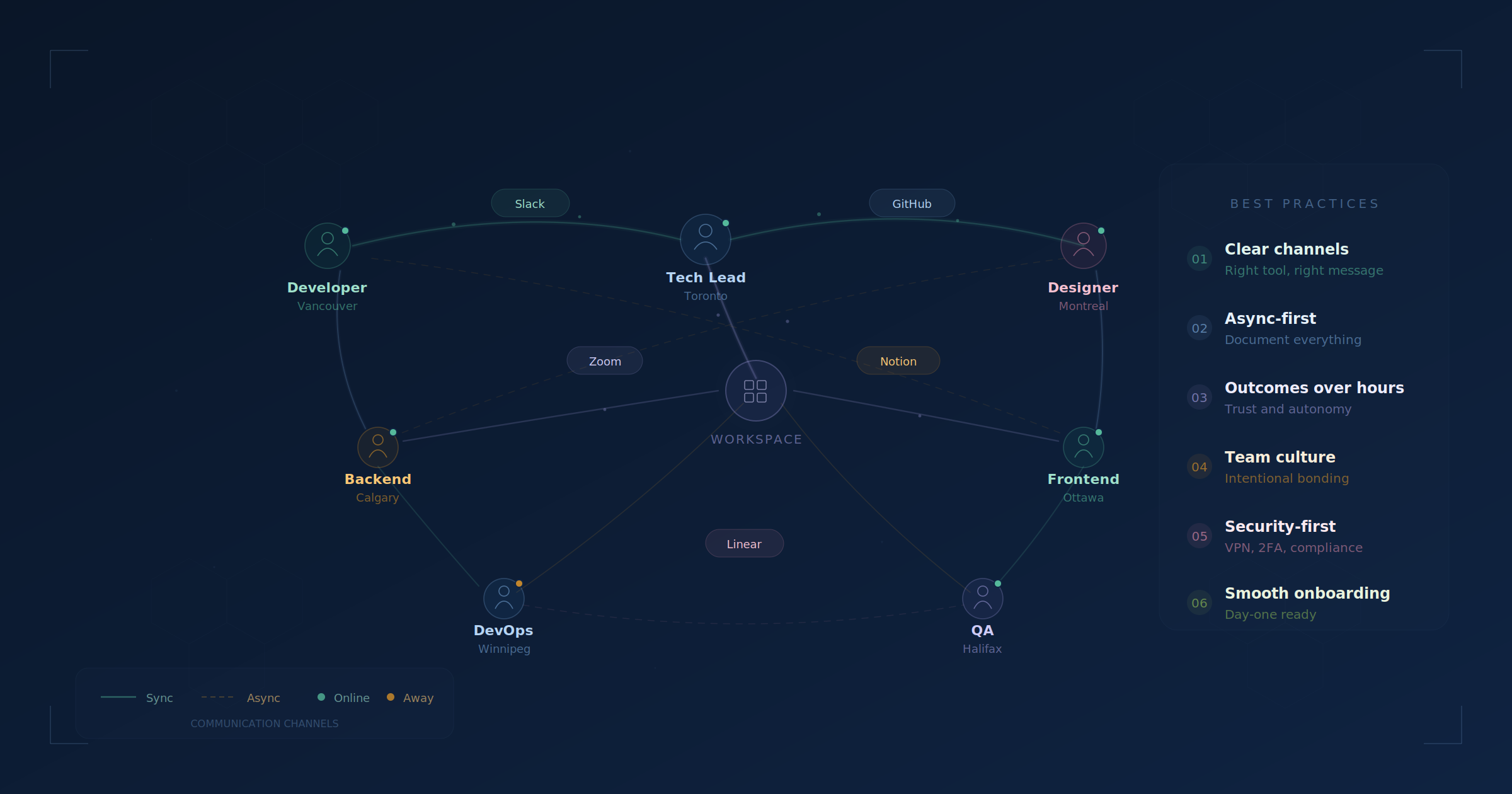
Build high-performing remote teams with Canadian developers. Best practices for cross-border collaboration, timezone alignment, async workflows, and nearshore team integration for US companies.

September 2026
The Hidden Cost Erasing Your Nearshore Savings
You hired Canadian developers to save 30%. But broken hiring practices erase those savings entirely. Here's what actually works.