Why Time Zone Alignment Matters More Than Cost Savings in Tech Hiring
Time zone misalignment quietly kills productivity. Here's why nearshore hiring beats offshore, even when the hourly rate looks tempting.
You’ve probably been pitched on offshore development before. The cost savings sound incredible. 40% less than US rates. Maybe 50%. The spreadsheet makes the decision look obvious.
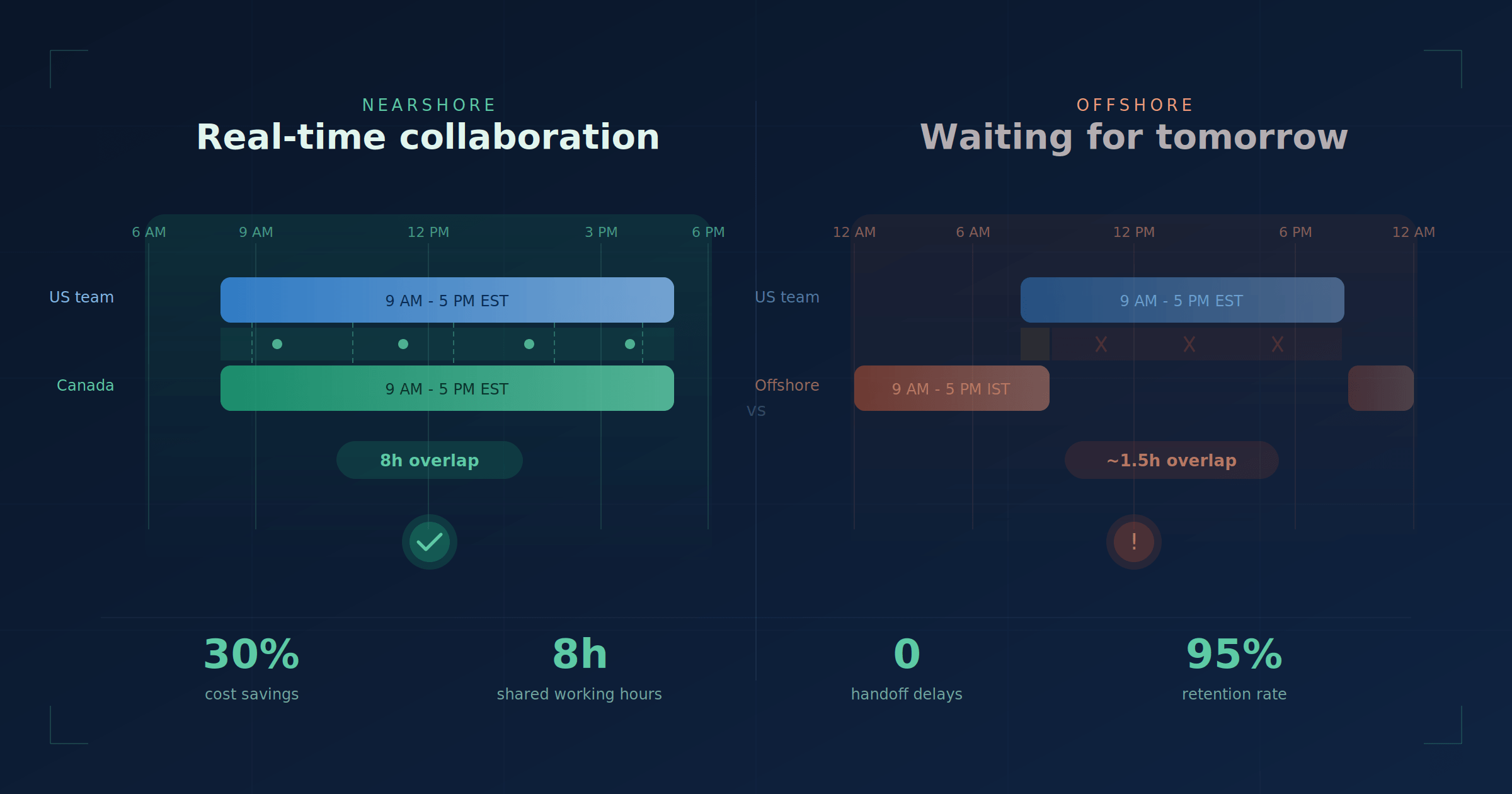
Then reality hits. Your team in Denver needs an answer from the developers in Bangalore, but they won’t be online for another 10 hours. The bug that should take an hour to fix now takes three days because of the handoff delays. Product decisions stall. Your sprint velocity drops. The “savings” start feeling expensive.
This is the hidden cost of time zone misalignment, and most companies don’t realize how much it’s costing them until they’ve already committed.
The Real Cost Isn’t in the Rate
When you hire offshore, the hourly rate is just one line item. But there are costs that don’t show up on the invoice:
Decision Latency
When your team can’t get real-time answers, everything slows down. Engineers block on questions. Product managers can’t iterate quickly. Each delay compounds. A decision that should take 10 minutes now takes a full day, minimum.
Context Loss
Asynchronous communication works for documentation and updates. It doesn’t work for nuanced problem-solving. When teams are never online together, context gets lost in translation. Slack threads become game of telephone. Misunderstandings multiply.
Meeting Fatigue
Someone always pays the cost of misaligned time zones. Either your US team is taking calls at 6 AM, or your offshore team is working at 10 PM. Both options burn people out. Neither is sustainable.
Reduced Velocity
Your team’s velocity isn’t just about how fast individuals code. It’s about how fast the entire system can move. When half your team is asleep during your workday, your system slows down. Sprints take longer. Releases get delayed. Customers wait.
Why Nearshore Changes the Equation
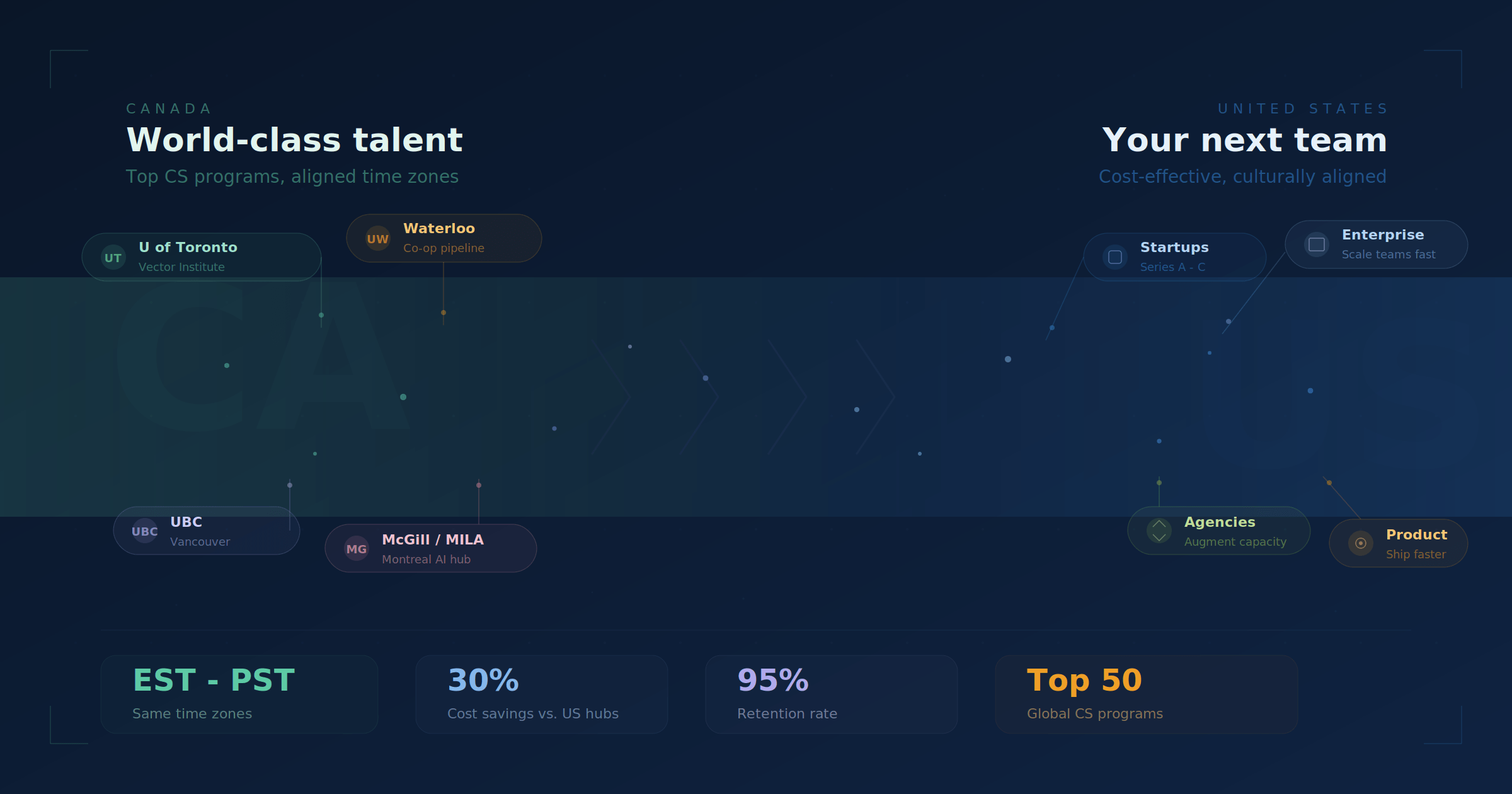
Nearshore hiring, particularly with Canadian talent, solves the time zone problem without sacrificing quality or cost efficiency.
Same Working Hours
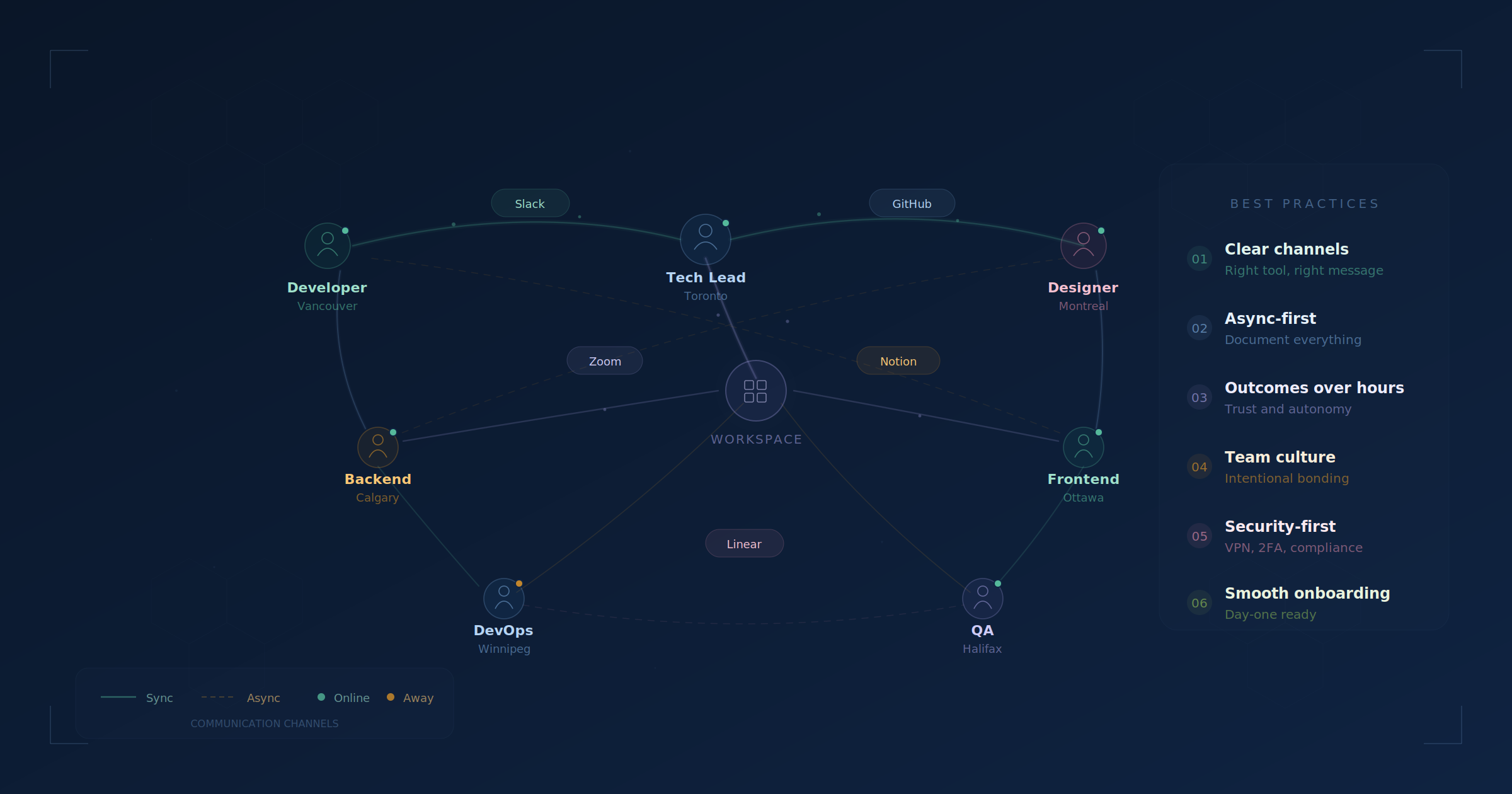
Canadian developers work the same hours as your US team. EST, CST, MST, PST. Pick your zone. Your Canadian engineers are online when you need them. No waiting. No handoffs. Just real-time collaboration.
Real-Time Problem Solving
When a production issue hits at 2 PM, your entire team can jump on it together. Not tomorrow. Not next sprint. Right now. This is how fast-moving teams actually operate.
Cultural Alignment
Canadian work culture aligns closely with US expectations. Communication styles, meeting norms, professional practices. This isn’t about one culture being better than another. It’s about reducing friction. When your team shares context, they move faster.
Cost Efficiency Without the Trade-off
Canadian developers typically cost 30% less than equivalent US hires. That’s meaningful savings. But you’re not trading away productivity to get it. You’re getting aligned time zones, cultural fit, and strong technical fundamentals. The cost efficiency comes from market dynamics, not from cutting corners.
What This Looks Like in Practice
A few scenarios we’ve seen play out:
The Sprint Planning That Actually Works
Your team plans a sprint on Monday morning. By Monday afternoon, everyone (including your Canadian developers) has context, asks clarifying questions, and starts moving. No waiting until Tuesday night for the offshore team to wake up and realize they need more details.
The Bug Fix That Doesn’t Take Three Days
A customer reports a critical bug at 11 AM. Your full-stack developer in Toronto picks it up, collaborates with your designer in San Francisco, and ships a fix by 3 PM. Total elapsed time: 4 hours. Not 3 days of async back-and-forth.
The Product Decision That Doesn’t Stall
Your PM wants to discuss a feature pivot. They pull the team into a quick call, hash it out in 30 minutes, and everyone gets back to work with clarity. No waiting 24 hours for responses. No misaligned expectations.
When Cost Savings Actually Cost More
We’ve talked to plenty of companies who tried offshore first. The math looked good. Then they hit the reality of misaligned schedules and realized they were paying in other ways:
Slower product iteration. Features that should ship in two weeks take a month because every decision has a 12-hour delay built in.
Higher management overhead. Someone has to coordinate across time zones, manage handoffs, and fill in context gaps. That’s a hidden full-time role.
Lower team morale. Engineers get frustrated when they can’t get unblocked. PMs get frustrated when they can’t move fast. Burnout creeps in.
Opportunity cost. Every week you’re moving slower than you could be, your competitors are shipping. Market windows close. Customers go elsewhere.
None of this shows up on the initial cost comparison. But it’s real, and it’s expensive.
What to Prioritize When Hiring Remote Talent
If you’re building a distributed team, here’s what actually matters:
1. Overlap in working hours. Aim for at least 6 hours of shared working time. Ideally more. This is non-negotiable for teams that need to move fast.
2. Communication clarity. Time zone alignment helps, but it’s not enough on its own. Look for developers who communicate clearly in writing and verbally. This matters more than most technical skills.
3. Cultural fit around pace and process. Does this person understand your urgency when you say “this needs to ship this week”? Do they share your team’s working norms? Misalignment here creates friction even with perfect time zone overlap.
4. Long-term retention potential. Hiring is expensive. Onboarding is expensive. Optimize for people who will stay, not just people who are available now. This is where investing in career development and treating people well pays off.
5. Technical depth, not just keyword matching. You need people who can solve problems, not just check boxes on a resume. This is where technical vetting by people who actually build software makes a difference.
The DecodeTalent Approach
We focus on Canadian tech talent specifically because it solves the nearshore equation better than other options. Same time zones as the US. Strong engineering talent pool. Aligned work culture. Meaningful cost efficiency without the hidden productivity tax.
But we don’t just match time zones. We vet for the things that actually predict long-term success: technical depth, communication skills, cultural fit, career trajectory. Our 95% retention rate exists because we optimize for fit, not speed.
And we invest in our talent through the Decode Academy, which means the developers you hire through us are actively leveling up, not coasting.
The Bottom Line
Cost savings matter. But if you’re optimizing purely on hourly rate, you’re missing the bigger picture. The real question isn’t “what’s the cheapest option?” It’s “what’s the most effective option for building a high-performing team?”
Time zone alignment isn’t just a nice-to-have. It’s a productivity multiplier. It’s the difference between a team that moves fast and a team that’s constantly waiting.
If you’re hiring remote developers, don’t let a lower hourly rate blind you to the hidden costs of misalignment. Nearshore hiring gives you the cost efficiency you need without the friction you can’t afford.
Talk to us about building a team that’s both cost-effective and actually effective.